Amphibian Facts
Did you know...?
Diversity

The most species rich genus of frogs is Pristimantis. There are more than 500 species in this genus, with more being described each year (see the full list here). These frogs occur in northern South America, mostly in the Andes, with some species found in southern Central America. They are small frogs whose eggs are laid on land and develop directly into small froglets, bypassing the tadpole stage.
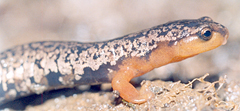
The most diverse genus of salamanders, with more than 120 species (get the latest tally for Bolitoglossa here), is Bolitoglossa (the "web-footed salamanders"). Members of this genus are found from Mexico throughout Middle America and most of South America to central Bolivia. These are salamanders that lack an aquatic larval stage, are terrestrial rather than aquatic as adults, and frequently are arboreal. The best known species is probably Bolitoglossa pesrubra, common in the highlands of Costa Rica, where it has been seen by many biologists taking the classes of the Organization for Tropical Biology.
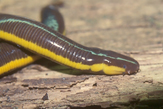
The most species rich genus of caecilians is Ichthyophis, numbering 50 or more species, and occurs throughout much of southeastern Asia, including many of the Philippine, Malaysian and Indonesian islands. These animals burrow and are rarely seen unless one searches specifically for them. This family counts among them some of the most colorful caecilians with bright yellow stripes or yellow all over.
Life as an Amphibian
The typical life cycle of amphibians is a larval stage that lasts a few months, followed by a brief metamorphic period, then a long, multiyear life on land. The adults return to the water to court and ultimately lay eggs. However, there are many exceptions. Among frogs, those of the genus Pristimantis lay eggs on land, which develop directly into miniatures of adults with no tadpole stage. These are the most widespread and commonly encountered frogs in the New World tropics. In Africa the genus Arthroleptis (known as "squeakers") are all direct developers. There are also many other direct developing frogs on Madagascar and in southeast Asia. Among salamanders most species of the largest family, Plethodontidae, are direct developers. There are also direct developing caecilians.
A few species of frogs give birth to live young. Members of the African genus Nectophrynoides retain eggs in the oviduct and some nourish the young as they grow. These are born as miniatures of the adult. One Puerto Rican species of the genus Eleutherodactylus, now thought to be extinct (E. jasperi), also retained eggs in the oviduct and had live birth. Salamandra salamandra, S. atra and some related species either give birth to larvae or to completely metamorphosed juveniles.
Many species of caecilians give birth to living young, usually fully metamorphosed at birth. Live-bearing caecilians provide nutrition to their developing embryos. The young have well developed jaws and teeth which they use to scrape secretions, called "uterine milk", from the walls of the oviducts.

Lunglessness
Some amphibians have lost their lungs evolutionarily. Instead of needing to breathe air with lungs, they absorb all of their needed oxygen through their moist skin. There are lungless species in all three amphibian orders.
The only lungless frog species known is Barbourula kalimantanensis, the Bornean flat-headed frog.
The largest family of salamanders, with over 400 species, is entirely lungless, the Plethodontidae.
There are only two known lungless caecilians, one aquatic and one terrestrial. The terrestrial lungless caecilian is Caecilita iwokramae, which is also the smallest New World caecilian. Atretochoana eiselti is the only known lungless aquatic caecilian, and is found in Brazil. It also holds the record for largest lungless tetrapod alive today, reaching 1 meter in length.
Unique Talents
Salamander escape
Hydromantes platycephalus, the Mount Lyell Salamander, lives under rocks on talus slopes. When the rock is lifted up, the salamanders curl into a ball and roll away down the hillside away from potential predators.
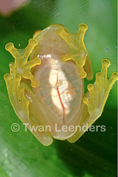
Glass frogs are frogs in the family Centrolenidae. Many frogs in this family have transparent skin (particularly on their underside), through which you can see their internal organs. Many have green bones!
Frozen Frogs
The wood frog, Rana sylvatica, live in places as far north as Canada and Alaska, and are able to survive the freezing winters by allowing itself to freeze, but limiting the damage by using cryoprotectants (such as glucose and urea in the blood) to reduce internal ice formation.
Parental care and Reproduction
Strawberry Poison Dart Frogs, Oophaga pumilio, avoid laying their eggs in ponds and streams. Instead, the eggs develop on land until the tadpoles are ready to hatch. Then the mother carries the tadpoles on her back to water-filled bromeliads (epiphytic plants) in the trees. The tadpoles complete their development in these tiny, predator-free pools, and the mother feeds them with unfertilized eggs.
Males of Rhinoderma darwinii, Darwin's Frog, brood their developing young in their vocal sacs until they metamorphose. Female Gastric-brooding frogs, Rheobatrachus silus, brood the developing young in their stomachs. They do not feed at all through the developmental period, and can have over 20 young.

The Surinam toad, Pipa pipa, attaches its eggs to the backs of the females, where skin grows over them. The young then develop for several months in the safety of their mothers back until they emerge as fully metamorphosed froglets.
Live-bearing caecilians provide nutrition to their developing embryos. The young have well developed jaws and teeth that they use to scrape secretions, called 'uterine milk', from the walls of the oviducts.
The common reed frog, Hyperolius viridiflavus, found in forests and savannahs in Africa, is able to change its sex (from female to male) when there are not sufficient males in the population.
The paradoxical frog, Pseudis paradoxa, gets its name from a unique life history trait it possesses. The tadpoles of this frog are very large (up to 22 cm), and can grow to three to four times the length of the adult.
Record holders: The Biggest, the Smallest, the Highest....

The largest amphibian (and salamander) in the world is the Chinese Giant Salamander, Andrias davidianus, reaching up to 1.8 m in length from the nose to the tip of the tail. An animal that was 1.15 m long weighed 25 lbs!
The largest frog is the Goliath Frog Conraua goliath, an African species that can reach up to 32 cm in length and weigh over 3 kg.

The largest caecilian is Caecilia thompsoni, which reaches 151.5 cm; the smallest is Grandisonia brevis at 11.2 cm but a female of Idiocranium russeli was gravid at 0.90 cm.
The smallest salamander is probably Thorius arboreus. Several members of the genus Thorius achieve sexual maturity at about 15 mm snout to vent length. T. arboreus from the Sierra de Juarez of Oaxaca is the smallest species, because the largest known adult is a female (the larger of the two sexes in this genus) that was only 20.0 mm snout-vent length (Hanken and Wake, Copeia, 1998).
The smallest known frog species is Paedophryne amauensis, a forest dwelling frog from Papua New Guinea with an average body size of 7.7mm. It is also the world's smallest known vertebrate.
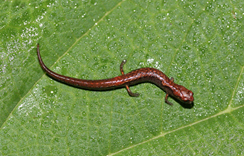
How high can amphibians live? Lots of amphibians reach 4,000 m in elevation but very few frogs and salamanders go much higher. Caecilians generally are found below 1,500 m to sea level.
The salamander that lives at the highest elevation is Pseudoeurycea gadovii, which can be found above 5,000 meters on the volcano Pico de Orizaba in Mexico.
The frog which inhabits the highest elevation may be Scutiger boulengeri, which has been found as high as 5,100m The highest frog could also be probably a member of the genus Telmatobius. Some species in this genus can be found at close to 5,000 meters.
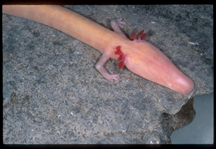
The longest living amphibian is probably the olm, Proteus anguinus. Individuals have been kept in captivity for over 70 years, and the predicted maximum lifespan is over a century! Other long-lived amphibians include a Salamandra salamandra that lived for 50 years in captivity, and an Andrias japonicus that lived for 55 years. An Ambystoma maculatum in nature was estimated from skeletochronology to be 27 years old. A Bufo bufo lived 36 years in captivity (Duellman and Trueb 1986).
Word Play

Collective Nouns:
A group of frogs can be called an army, chorus, or colony.
A group of toads can be called a knot or a nest.
A group of salamanders can be called a band.
What is a Newt?
All newts are salamanders, but not all salamanders are newts. The word "Newt" is refers to certain aquatic salamanders (specifically those found in the subfamily Pleurodelinae). The word "eft" is used to describe the terrestrial juvenile stage of the newt lifecycle.

What do frogs have in their mouths that toads don't?
Teeth. Most frogs have teeth on the upper jaw but none on the lower jaw (only one frog has teeth on the lower jaw: a South American species named Gastrotheca guentheri, Guenther's Marsupial Frog). The word "toad" is an informal name applied to the large frog family Bufonidae, and these animals (along with some frogs in other families) all lack teeth entirely.
Can you tell a male from a female frog just by looking at them? In many species, you can! The males may be differently colored than the female, or the female may be much larger than the male, or any combination of differences in size and color. Biologists call differences in body size or color based on sex "sexual dimorphism" and when the sexes are differently colored, sometimes strikingly so, it is called "Sexual Dichromatism". Read more about this colorful phenomena here.
What is your favorite amphibian fact? We love to hear from you, so contact us and let us know your favorite amphibian fact and the source where you found it. If you are interested in a particular species, and there is no account for it, let us know if you would like to write an account.
Go to Amphibians by the Numbers!