
|
Arenophryne rotunda Tyler, 1976
Northern Sandhill Frog | family: Myobatrachidae subfamily: Myobatrachinae genus: Arenophryne |
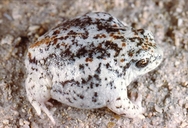 © 2008 Brad Maryan (1 of 1) |
|
|

|
Description Skin coloration may vary from off-white to cream to light green, overlain with irregular blotches of brown or brick-red speckles (Government of Western Australia 2010). Distribution and Habitat Country distribution from AmphibiaWeb's database: Australia
This frog is endemic to a limited a strip of land along the coastal zone in southwest Australia within the Southwest Australian savanna ecoregion, including the arid zones from Shark Bay (Edel Land) southward to the Murchison River of Western Australia (Hero and Roberts 2004). A. rotunda also occurs on Dirk Hartog Island. The estimated altitudinal range of the species is from sea level to 150 meters above mean sea level. Population densities have been estimated as great as 277 individuals per hectare (Tyler 1998). A. rotunda chiefly occurs in limited extents of the coastal dunes of the Southwest Australia savanna. Principal habitats are comprised of course-grained sand. This fossorial species requires no standing water in any form for its survival or breeding; however, residual soil moisture retained in dunes soil is critical for the survival of this anuran, particularly due to the arid climate and its sparse mercurial precipitation. Biomass density of this species has been estimated at 530 grams per hectare (Tyler 1998). Life History, Abundance, Activity, and Special Behaviors For several Australian desert frog species, an adaptation to aridity is via the formation of a cocoon layer, where cytomorphosis occurs at the outer layer of the skin. This outer layer may be shed all at once as new deeper skin cells push outward (Tyler 1998). A. rotunda achieves hydration by burrowing into a soil layer with sufficient moisture content to maintain hydration balance during its diurnal burrowing; in fact, contact with soil moisture of as low as 1.5 percent is sufficient to achieve such hydration balance by skin osmosis (Cartledge et al. 1996). A. rotunda feeds primarily on ants and other insects, and may travel about thirty meters on land in search of food; locomotion is by way of crawling rather than hopping (Government of Western Australia 2010). In the austral spring, A. rotunda males begin to produce mating vocalizations. Anuran pairs of this species summer together (December to March) underground and then eggs are deposited in austral autumn (usually around the month of April) (Roberts 1984). A clutch of sizable creamy white eggs up to five millimeters in diameter are deposited in deep burrows up to 80 centimeters beneath the ground surface in moist sand. Minute frogs hatch from the eggs after approximately nine weeks, so that there is no tadpole phase (Tyler et al. 1994). Trends and Threats While there are no specific known threats to this species, there are instances of coastal overgrazing near the protected area that promote concern. There is also the theoretical concern that future coastal development pressures, including tourism itself, could reduce the effective fragile dune habitat of this frog. The greatest threat, however, is the possibility of a prolonged drought which could greatly reduce the protective soil moisture burrowing habitat of A. rotunda and cause a catastrophic population decline, given the very limited species range.
Conservation Measures Comments Species Associates Notable reptile associates include a swimming skink, the Vulnerable Shark Bay ctenotus (Ctenotus zastictus), which is also found on the dunes of Shark Bay; and the Christina's lerista (Lerista christinae), a species also endemic to the coastal zone of the Southwestern Australian savanna; and the Endangered woma (Aspidites ramsayi). Notable mammals with overlap or near overlap of range include the Near Threatened black-footed rock wallaby (Petrogale lateralis), although the limits of this wallaby's distribution have shrunk due to its recent population decline.
References
Barker, J., Grigg, G. C., and Tyler, M. J. (1995). A Field Guide to Australian Frogs. Surrey Beatty and Sons, New South Wales. Cartledge, V.A., Withers P.C., Thompson G.G., and McMaster K.A. (2006). ''Water Relations of the Burrowing Sandhill Frog, Arenophryne rotunda.'' Journal of Comparative Physiology B: Biochemical, Systemic, and Environmental Physiology, 176(4), 295-302. Hero, J. & Roberts, D. 2004. Arenophryne rotunda. In: IUCN 2012. IUCN Red List of Threatened Species. Version 2012.2. www.iucnredlist.org. Downloaded on October 2012. Hogan, C.M. & World Wildlife Fund. 2012. Southwest Australia savanna. Ed. Peter Saundry. Encyclopedia of Earth. National Council for Science and the Environment, Washington DC, USA Roberts, J.D. (1984). ''Terrestrial egg and deposition and direct development in Arenophryne rotunda, a myobatrachid frog from the coastal sand dunes at Shark Bay, Western Australia.'' Australian Wildlife Research, 11, 191-200. Tyler, M. J. (1998). Australian Frogs: A Natural History. Cornell University Press, Ithaca, New York. Tyler, M.J., Smith, L.A., and Johnstone, R.E. (1994). Frogs of Western Australia. Western Australian Museum, Perth. Originally submitted by: C. Michael Hogan (first posted 2002-04-05) Edited by: Michelle S. Koo (2021-03-17) Species Account Citation: AmphibiaWeb 2021 Arenophryne rotunda: Northern Sandhill Frog <https://amphibiaweb.org/species/3547> University of California, Berkeley, CA, USA. Accessed Apr 25, 2024.
Feedback or comments about this page.
Citation: AmphibiaWeb. 2024. <https://amphibiaweb.org> University of California, Berkeley, CA, USA. Accessed 25 Apr 2024. AmphibiaWeb's policy on data use. |
 Map of Life