|
Ambystoma annulatum Cope, 1886
Ringed Salamander Subgenus: Linguaelapsus | family: Ambystomatidae genus: Ambystoma |
| Species Description: Cope, E. D. (1886). Synonymic list of the North American species of Bufo and Rana, with descriptions of some new species of Batrachia, from specimens in the National Museum. Proceedings of the American Philosophical Society 23, 514–526. | |
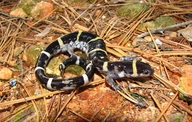 © 2006 Michael Graziano (1 of 18) |
|
|


|
Description In life, the dorsal color of adults ranges from dark gray to blackish brown, with contrasting white to yellowish bands. Ventrally, the color varies from light gray to yellowish, peppered with light-colored spots. There is typically a short, light colored bar between the eyes that may continue below the eyes to point diagonally posterior. Recently metamorphosed juveniles have a drab green to dark gray dorsal surface, and a row of dorsolateral yellowish spots extending from the front limbs to the tip of the tail. Laterally, a broad band runs from the gills two-thirds of the way down the tail, which lacks pigmentation. Bellies are grayish-yellow. Juveniles develop the blotches or rings that characterize this species approximately two months after metamorphosis (Hutcherson et al. 1998). The sexes are monomorphic and it is unknown whether there is any geographic or seasonal variation (Bishop 1962; Johnson 1977; Petranka 1998). Distribution and Habitat Country distribution from AmphibiaWeb's database: United States U.S. state distribution from AmphibiaWeb's database: Arkansas, Missouri, Oklahoma
Ambystoma annulatum is found in damp forested areas, usually under leaves, rotting logs, or in abandoned ground holes of other organisms, near shallow ponds. This species is highly fossorial (adapted to digging), and adults are often found in subterranean refuges (Petranka 1998). Life History, Abundance, Activity, and Special Behaviors This species is secretive and fossorial and is generally not seen except on rainy autumn nights during breeding season. Breeding has been observed by a number of authors (Noble and Marshall 1929; Trapp 1956, 1959; Spotila and Beumer 1970; Hutcherson et al. 1989). Ambystoma annulatum breeds in shallow, fishless water (permanent or temporary ponds) and exhibits a preference for muddy or murky bodies of water. Adults migrate to breeding areas after the first heavy rains of the autumn breeding season (mid-September through November, most commonly in October, though the exact times vary depending on the local habitat). Cool temperatures and heavy rainfall stimulate breeding. This species is an explosive breeder and breeding males may try to reproduce 2-4 times in a season (Petranka 1998). Breeding occurs at night in breeding ponds, where hundreds of individuals congregate. The males usually arrive first, and can be distinguished from the females by their swollen cloacae (Bishop 1962). Males usually approach the females in shallow water and engage in courtship by nudging the female’s cloaca (Johnson 1977). They then deposit a spermatophore a few centimeters away; a male may deposit nine spermatophores in two minutes. The male may repeat this process several times; however, the female will pick up the spermatophore only after being actively courted. The more males in the pond, the less specifically they court, and they will nudge both males and females before depositing a spermatophore (Petranka 1998). Males deposit spermatophores on rocks, other spermatophores, and even each other. After breeding, the salamanders begin to move away from the pond (Bishop 1962). Fertilization is internal (Petranka 1998). A day or two after mating (24-48 hours), the female deposits between 5 and 40 eggs (mean of 10), in strings or small masses (Petranka 1998). Generally she lays the egg mass (usually about 150 eggs total) directly on the pond bottom, but she may attach them to submerged vegetation (Petranka 1998). Females may distribute the clutch in several egg masses, resorb some ova, or lay only a portion of the clutch on any given night, since Hutcherson et al. (1989) found that females in captivity had considerably more ovarian eggs than were counted in oviposited masses examined by Trapp (1959). In Missouri, permanent ponds used for breeding had a bottom substrate consisting of a thick layer of leaf litter and manure (Hutcherson et al. 1989). Eggs measure approximately 2 mm in diameter and hatch after 9-16 days (a relatively short embryonic period), again depending on the exact location (Petranka 1998). Eggs can survive temporary dry periods out of the water, with Hutcherson et al. (1989) reporting that eggs were deposited in one pond even though there was no standing water; those deposited within mud cracks or under partial shade from vegetation survived for 14-19 days until the pond refilled and hatching could occur. To get an idea of the maximum survival period out of water, Hutcherson et al. (1989) collected 879 embryos from the pond basin and incubated them at 17°C on moist soil under moist paper towels for 52 days. Twenty embryos survived and all hatched within five minutes of being submerged in water after 52 days out of water. Mature aquatic larvae are on average 48 mm in length, and have well-developed legs, toes, and a dorsal fin that extends to the head (Petranka 1998). They typically begin metamorphosis the following February through May (Petranka 1998), although Hutcherson et al. (1989) observed larvae leaving one of their Missouri study ponds during June and early July. Newly metamorphosed juveniles measure approximately 34-40 mm in length and soon begin to crawl onto land in search of underground abodes, particularly on rainy days (Hutcherson et al. 1989). Sexual maturity is attained in the second or third year of life (Petranka 1998). As an adult, this carnivore preys mostly on earthworms, insects, and land snails (Johnson 1977). Hutcherson et al. (1989) found that only 3 of 16 females examined had food in the stomach, and were unable to identify the contents. Trapp (1959) found that only 3 of 23 salamanders had prey items in the stomach (one with unidentifiable stomach contents, two containing earthworms). Newly transformed salamanders mostly had empty stomachs (24 of 30) when examined by Hutcherson et al. (1989), but some (6 of 30) had fly larvae in the stomach. Larvae eat a variety of prey, with Hutcherson et al. (1989) finding cladocerans and copepods the main components of the larval diet in autumn, dipteran larvae during winter and spring, and other occasional larval prey items including ostracods, dragonfly and damselfly nymphs, hemipterans and snails. In contrast, Trapp (1959) found that cladocerans and copepods comprised the bulk of the diet in spring (March and April), with minor components including molluscs, eggs, and Chironomus; Trapp (1959) also concluded that cladocerans and copepods were consumed preferentially, based on an analysis of food item abundance in water samples. Larval cannibalism has also been observed, both in the wild and the lab (Hutcherson et al. 1989; Nyman et al. 1993). Natural predators of adults include owls, snakes, shrews, skunks, raccoons, opossums, and other mammals. When attacked or feeling threatened, A. annulatum coils its body while tucking the head underneath the base of the tail for protection (Petranka 1998). Young larvae are preyed on by newts (Notophthalmus viridescens louisianensis, among other species) but larger ringed salamander larvae became too big for the Notophthalmus to consume at about a month prior to larval metamorphosis (Wilson 1993). In laboratory experiments comparing larval ringed salamander responses to predator (newt) vs non-predator (tadpole) chemical stimuli, larval Ambystoma annulatum were able to distinguish chemical signals of predatory newts and smaller larvae subsequently decreased activity. Other predators of ringed salamander larvae include aquatic insects, other aquatic salamanders, wading birds, and snakes (Mathis et al. 2003). Ringed salamanders can harbor a variety of endoparasites. McAllister et al. (1995) found that 83% of the salamanders in their sample (n=41) carried at least one parasite species. Endoparasites included ascarid (Cosmocercoides variabilis, in the rectum and feces), spirurid (species unknown, encysted in the stomach wall) and rhabditid nematodes (Rhabdias ranae, in the lungs and body cavity), and a myxosporean protozoan, Myxidium serotinum (in the gall bladder). Trends and Threats Possible reasons for amphibian decline General habitat alteration and loss Comments
References
Behler, J.L. and King, F.W. (1996). National Audubon Society Field Guide to North American Reptiles and Amphibians. Knopf, New York, NY. Beltz, E. (2002). ''Names of the reptiles and amphibians of North America.'' Original Description Citations for the Reptiles and Amphibians of North America. Bishop, S.C. (1962). Handbook of Salamanders. Hafner, New York, NY. Hutcherson, J. E., Peterson, C. L. and Wilkinson, R. F. (1989). ''Reproductive and larval biology of Ambystoma annulatum.'' Journal of Herpetology, 23, 181-183. Johnson, T.R. (1977). The Amphibians of Missouri. University of Kansas Publications, Lawrence, KS. Mathis, A., Murray, K. L., and Hickman, C. R. (2003). ''Do experience and body size play a role in responses of larval ringed salamanders, Ambystoma annulatum, to predator kairomones? Laboratory and field assays .'' Ethology, 109, 159-170. McAllister, C. T., Trauth, S. E., and Cochran, B. G. (1995). ''Endoparasites of the ringed salamander, Ambystoma annulatum (Caudata: Ambystomatidae), from Arkansas.'' The Southwestern Naturalist, 40, 327-330. Noble, G. K., and Marshall, B. C. (1929). ''The breeding habits of two salamanders.'' American Museum Novitates, 347, 1-12. Nyman, S., Wilkinson, R. F., and Hutcherson, J. E. (1993). ''Cannibalism and size relations in a cohort of larval ringed salamanders (Ambystoma annulatum).'' Journal of Herpetology, 27, 78-84. Petranka, J. W. (1998). Salamanders of the United States and Canada. Smithsonian Institution Press, Washington D.C. and London. Spotila, J. R., and Beumer, R. J. (1970). ''The breeding habits of the ringed salamander, Ambystoma annulatum (Cope), in northwestern Arkansas.'' American Midlands Naturalist, 84, 77-89. Trapp, M. M. (1956). ''Range and natural history of the ringed salamander Ambystoma annulatum, Cope (Ambystomatidae), .'' Southwestern Naturalist, 1, 78-82. Trapp, M. M. (1959). Studies on the Life History of Ambystoma annulatum Cope. Master's Thesis. University of Arkansas, Fayetteville. Wilson, T. J. (1993). ''.'' Predation of Ringed Salamander Larvae, Ambystoma annulatum. Southwest Missouri State University, M.S. Thesis, Springfield. Originally submitted by: Charles P. McCormick (first posted 2002-11-26) Edited by: Kellie Whittaker (2023-08-11) Species Account Citation: AmphibiaWeb 2023 Ambystoma annulatum: Ringed Salamander <https://amphibiaweb.org/species/3825> University of California, Berkeley, CA, USA. Accessed Apr 19, 2024.
Feedback or comments about this page.
Citation: AmphibiaWeb. 2024. <https://amphibiaweb.org> University of California, Berkeley, CA, USA. Accessed 19 Apr 2024. AmphibiaWeb's policy on data use. |
 Raffaëlli Account
 Map of Life