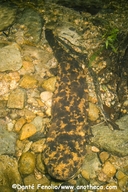
Description Andrias japonicus is a heavily built, large salamander, and with its Chinese sister species, Andrias davidianus, is one of the two largest extant salamander species. Head broad and flat. Body strongly depressed; terminal two-thirds of tail strongly compressed; nostrils small, near tip of the snout, their distance from each other less than one-half the distance between the eyes, which are without eyelids and very small. Vomerine teeth in an arched series starting between the choanae, parallel to the maxillary and premaxillary series. Thin lower labial fold starting midway between nostril and eye to angle of mouth. Legs short and flattened. Tail short, slightly more than one-third the length of head and body, with a high dorsal fin beginning at insertion of hind legs, and a lower ventral fin. Skin rather smooth and slippery, with wrinkles, folds and tubercles.
No external sexual dimorphism. During the breeding season, cloacal lips are swollen in the male and flat in the female.
Color usually reddish-brown to brownish-yellow, paler below; irregularly blotched and marbled with dusky spots. Considerable individual variation ranging from being completely black to almost yellow.
Total length of an adult Japanese Giant Salamander ranges from 30 to 150 cm - with a snout vent length of 20 to 90 cm - a result of continuous growth after sexual maturity (Kawamichi and Ueda 1998). Many specimens found in the wild are 60-70 cm (Environment Agency of Japan 2000). Weight of sexually mature animals ranging between 1.5 and 35 kg. The heaviest specimen found in the wild, on record, was 26.3 kg and measured 136 cm (Tochimoto, pers. com).
Genetic variation is low (Matsui and Hayashi 1992, Matsui et al. 2008).
The Japanese Giant Salamander is closely related and very similar to the Chinese Giant Salamander (A. davidianus) and differs from the latter by the arrangement of tubercles on the head and throat. These tubercles are larger and more numerous than in A. davidianus; they are mostly single and irregularly scattered. The snout is more rounded and the tail a little shorter in the Japanese species.
The Japanese Giant Salamander is endemic to Japan, where it is found in the Chubu, Kinki and Chugoku regions of central and western Honshu, in Shikoku and in northeastern Kyushu (Tochimoto 1996).
The salamander occurs in habitats ranging from relatively large rivers (20-50 m wide) to small tributary streams (1-4 m wide), with clear cool water flowing through granite and schist regions. These streams have usually rocky or gravel bottoms, and at places shallow, quietly running water. The animals keep themselves concealed in rocky caverns or in burrows on the water’s edge (Tago 1927). Vertical distribution 300 to 1000 m. Spawning nests and larvae often occur in relatively small lotic habitats, including the upper reaches of tributary streams (Okada et al. 2008).
Life History, Abundance, Activity, and Special Behaviors Spawning occurs in late August to early September. Eggs are deposited in long strings, containing 400-600 eggs. Diameter of egg 5 mm; diameter of external gelatinous capsule 8 to 15 mm. At water temperatures between 8° and 18° C embryonic development takes 40 to 60 days (Kuwabara et al. 1989). Larvae hatch in October-November at a total length of 30 mm and start feeding after absorption of yolk. One year old larvae measure about 100 mm, three year olds some 200 mm. At this size larvae start losing their gills. Males reach sexual maturity at 30 cm, females at 40 cm. The larval period is about 4-5 years, and it takes another 10 years to reach adulthood (Ministry of the Environment, Japan 2008).
The salamanders are entirely aquatic and nocturnal. They feed on fresh-water crabs, fish, small amphibians (Tago 1927), and additionally on aquatic insects and small mammals (Goris and Maeda 2005). Males and females have overlapping home ranges and are more or less sedentary outside the spawning period. During the breeding season, in August-September, both sexes congregate at underwater nest sites, consisting of 100 to 150 cm long burrows into or near the river bank. Nests have a single entrance opening underwater. Favorable nest sites may be used during successive years. Both males and females may occupy more than one nest at the time, with large and heavy males ("den-masters") attempting to monopolize occupancy of the nest sites. Nests are guarded from inside by males, attacking other males who try to enter. Males may also patrol around the nest area, chasing and attacking other males. Females enter the nests more than once and lay their eggs in the cavity, where they are fertilized by the male. At this stage several other males may intrude and try to fertilize the eggs. After spawning, den-masters remain at the nests for more than one month and aggressively guard the eggs until hatching occurs or until late October. Dominance rank of den-masters among males attempting to breed appears to be strong. Dead and heavily injured males have often been found during September (Kawamichi and Ueda 1998).
Thanks to new field studies of A. japonicas, we now know that males provide parental care, and for a very long period of time. Males actively seek burrows in stream banks that might serve as sites for mating and nesting. Females enter the burrow, occupied by a "den master" male and mating and external fertilization of the eggs takes place. The den master then provides parental care (tail fanning, agitation of eggs, and hygienic filial cannibalism of unfertilized eggs, or dead or dying embryos and larvae and other specialized behaviors) (Takahashi et al. 2016). Such behavior occurs over a long time period, up to seven months. The study adds substantial new information concerning egg deposition and parental care in nature, and will be critical for attempts to improve habitat and other recovery attempts for these amazing animals.
Trends and Threats The range of this species is severely fragmented (Ohno 1981). A continuing decline is observed in extent and quality of habitat and in the number of locations where the animal is found (Matsui and Hayashi 1992). Weirs, dams and river bank reinforcements constructed for flood and erosion control, agriculture, hydraulic power generation and road construction severely impact a large part of A. japonicus's riverine habitat (Okada et al. 2008). The animal used to be hunted for food and medical purposes. In Japan the species is fully protected by law since 1952; it is classified as rare (Kato and Ota 1993) and considered to be Near Threatened (Environment Agency of Japan 2000, Ota 2000). The species is listed under Appendix I of the Convention on International Trade of Endangered Species (CITES) (Ministry of the Environment, Japan 2008, IUCN 2010).
Although the prevalence of chytrid infection appears to be high in wild individuals (47 of 126 animals sampled, or 37.3%, were infected with Batrachochytrium dendrobatidis, or Bd), neither infected wild nor infected captive A. japonicus have been reported to show any signs of disease (Goka et al. 2009). Examination of formalin-fixed A. japonicus museum specimens has revealed the presence of Bd infection in specimens collected as early as 1902 (Goka et al. 2009). In addition, Bd haplotypes found on wild A. japonicus are genetically distinct from other strains, including those found on introduced bullfrogs, and Bd genetic variation is higher in Japanese endemic strains of Bd than for strains found in the U.S.A., Ecuador, or Italy (Goka et al. 2009). Taken together, the evidence suggests that Bd is endemic to Japan (as well as having been introduced on non-native species such as bullfrogs) and that host-parasite co-evolution has occurred in the case of A. japonicus and Bd (Goka et al. 2009).
In 2012, genetic tests of the endemic Japanese Giant salamanders revealed that some were hybrids with escaped imported Chinese Giant salamanders, Andrias davidianus. Further the use of environmental DNA tests revealed hybrids at nine out of 37 tested sites in the Katsura River basin in Japan, where previous surveys had ruled them out. Fukumoto et al (2015) demonstrated the effectiveness of eDNA tests (testing for targeted species with PCR analysis of water samples) and that hybridization may be another threat to the endemic species.
Relation to Humans The species was first bred in captivity in the Amsterdam Zoo (Kerbert 1905). The Japanese Giant Salamander is extremely long lived. A specimen in the Amsterdam Zoo lived for 52 years (Tago 1927). Since 1979, Hiroshima City Asa Zoological Park is successfully breeding A. japonicus (Kuwabara et al. 1989). Presently (2010) the third generation is being raised in captivity. Researchers of Asa Zoo study Giant Salamander reproductive behavior by observing salamanders breeding in man-made holes in branches of the Shijihara River in Hiroshima Prefecture (Kuwabara and Nakagoshi 2009).
Eco-friendly works for habitat conservation have begun in some areas and attempts have been made to rebuild spawning places along the Ichi River (Tochimoto 1995, 1996).
Possible reasons for amphibian decline
General habitat alteration and loss Habitat fragmentation Loss of distinctiveness through hybridization
Comments A program in Japan is helping giant salamanders get past dams built to control flooding so the rare amphibians can lay their eggs upstream. December 31, 2009.
Video by Public Television's Wild Chronicles, from National Geographic Mission Programs.
Runtime: 3:38. Language: English.
Much of its extensive literature is written in Japanese. See Stejneger (1907), Sato (1943), Thorn (1969), and for recent ecological studies by T. Tochimoto and J. Kobara in Japanese, see references in Kawamichi and Ueda (1998).
References
Fukumoto S., Ushimaru A., and Minamoto, T. (2015). ''A basin-scale application of environmental DNA assessment for rare endemic species and closely related exotic species in rivers: a case study of giant salamanders in Japan.'' Journal of Applied Ecology, 52(2), 358 - 365.
Goka, K., Yokoyama, J., Une, Y., Kuroki, T., Suzuki, K., Nakahara, M., Kobayashi, A., Inaba, S., Mizutani, T., and Hyatt, A. D. (2009). ''Amphibian chytridiomycosis in Japan: distribution, haplotypes, and possible route of entry into Japan.'' Molecular Ecology, 18, 4757 - 4774.
Goris, R.C. and Maeda, N. (2004). Guide to the Amphibians and Reptiles of Japan. Krieger Publishing Company, Malabar, Florida.
IUCN. (2010). IUCN Red List of Threatened Species. Version 2010.2. http://www.iucnredlist.org. Accessed on 16 September 2010.
Japan Agency of Environment (2000). Threatened Wildlife of Japan - Red Data Book. 2nd ed. Reptilia/Amphibia. (in Japanese with English summary). Japan Wildlife Research Center, Tokyo, Japan.
Kato, T. and Ota, H. (1993). Endangered Wildlife of Japan. Hoikusha, Osaka, Japan.
Kawamichi, T. and Ueda, H. (1998). ''Spawning at nests of extra-large males in the Giant Salamander Andrias japonicus.'' Journal of Herpetology, 32, 133-136.
Kerbert, C. (1905). ''Über die Eier und Larven von Megalobatrachus maximus Schl.'' C. R. 6e Congr. Intern. Zool., Berne, 1904, 289-294.
Kobara, J. (1985). The Giant Salamander (in Japanese). Doubutsu-sha, Tokyo, Japan.
Kuwabara, K. and Nakagoshi, N. (2009). ''Analysis on Reproductive Behavior of Japanese Giant Salamander, Andrias japonicus - Observations on the Breeding Behavior and Notes on the Video Imagery.'' Natural History of Nishi-Chugoku Mountains, 14, 11-50 + DVD.
Kuwabara, K., Suzuki, N., Wakabayashi, F., Ashikaga, H., Inoue, T. and Kobara, J. (1989). ''Breeding the Japanese Giant Salamander at Asa Zoological Park.'' International Zoo Yearbook, London, 28, 22-31.
Matsui, M., Tominaga, A., Liu, W.-Z., and Tanaka-Ueno, T. (2008). ''Reduced genetic variation in the Japanese giant salamander, Andrias japonicus (Amphibia: Caudata) .'' Molecular Phylogeny and Evolution, 49, 318-326.
Matsui, M., and Hayashi, T. (1992). ''Genetic uniformity in the Japanese Giant Salamander, Andrias japonicus.'' Copeia, 1992, 232-235.
Ministry of the Environment, Japan, (2008). ''Review of the Status of Japanese Giant Salamander (Andrias japonicus).'' Annex 2 to Periodic Review of Species Included in the CITES Appendices, Geneva 2009, 5-14.
Ohno, M. (1981). "Megalobatrachus japonicus." Final Report of the Reptiles and Amphibians Survey of the Second National Survey on the Natural Environment of Japan. 1978, pt. 2. Nature Conservancy Society of Japan, Tokyo., 55-70.
Okada, S., Utsunomiya, T., Okada, T., Felix, Z.I., and Ito, F. (2008). ''Characteristics of Japanese Giant Salamander (Andrias japonicus) populations in two small tributary streams in Hiroshima Prefecture, Western Honshu, Japan.'' Herpetological Conservation and Biology, 3, 192-202.
Ota, H. (2000). ''Current status of the threatened amphibians and reptiles of Japan.'' Population Ecology, 42, 5-9.
Sato, I. (1943). A Monograph of the Tailed Batrachians of Japan (In Japanese). Nippon Shuppan-Sha, Osaka, Japan.
Stejneger, L. (1907). Herpetology of Japan and Adjacent Territory. Government Printing Office, Washington. Reprinted 1996, with an introduction by M. Matsui. Society for the Study of Amphibians and Reptiles in cooperation with the Herpetological Society of Japan
Stuart, S., Hoffmann, M., Chanson, J., Cox, N., Berridge, R., Ramani, P., Young, B. (eds) (2008). Threatened Amphibians of the World. Lynx Edicions, IUCN, and Conservation International, Barcelona, Spain; Gland, Switzerland; and Arlington, Virginia, USA.
Tago, K. (1927). ''Notes on the habits and life history of Megalobatrachus japonicus.'' Xe Congrès International de Zoologie, tenu à Budapest 1927. Budapest, Hungary, 828-838.
Takahashi, M. K., Okada, S. and Fukuda, Y. (2016), From embryos to larvae: seven-month-long paternal care by male Japanese giant salamander. J Zool. doi:10.1111/jzo.1243
Thorn, R. (1969). Les Salamandres d'Europe, d'Asie, et d'Afrique du Nord. Lechevalier, Paris, France.
Tochimoto, T. (1995). ''Ecological studies on the Japanese Giant Salamander, Andrias japonicus, in the Ichi River in Hyogo Prefecture. 10. An attempt to rebuild spawning places along the river.'' Journal of Japanese Association of Zoological Gardens and Aquariums, 37, 7-12.
Tochimoto, T. (1996). ''Amphibians, Reptiles, and Cartilaginous Fish, 5.'' The Encyclopedia of Japanese Animals. Hidaka, T., eds., Heibonsha, Tokyo, Japan.
Species Account Citation: AmphibiaWeb 2021 Andrias japonicus: Japanese Giant Salamander <https://amphibiaweb.org/species/3859> University of California, Berkeley, CA, USA. Accessed Apr 25, 2024.



 Raffaëlli Account
 Map of Life