
|
Rheobatrachus silus Liem, 1973
Southern Gastric Brooding Frog, Southern Platypus Frog | family: Myobatrachidae subfamily: Myobatrachinae genus: Rheobatrachus |
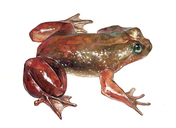 © 2009 Endangered Species International (1 of 1) |
|
|

|
Description Rheobatrachus silus was a medium-sized frog with a snout-vent-length of 33-41 mm for males, and snout-vent-length of 44-54 mm for females. The skin was finely granular dorsally and smooth ventrally. The snout was round and blunt, and nostrils were directed upwards. The eyes, also directed upwards, were large and projected outwards. The eyes were close together and were located to the front of the head. The tympanum was hidden. The toes were fully webbed to the tip, but the fingers did not have webbing. All of the digits had small discs. The tadpoles were bulbous, pale, low-finned, and did not have keratinized mouthparts (CITES 2013). Rheobatrachus silus could be differentiated from its sister taxa by its distribution, color pattern, and mottled webbing. It was also smaller than R. vitellinus (CITES 2013). The dorsal coloration ranged from olive to almost black and it had small light and dark patches scattered throughout. There was a dark streak that ran from the eye to the base of the forelimb. The limbs had dark crossbars and the digits and webbings had a variety of pale and dark patches. The white or cream ventral surface had yellow markings on the limbs. Tadpoles brooded in the stomach and initially lacked any pigmentation on their skin (Tyler and Davies 1983). Distribution and Habitat Country distribution from AmphibiaWeb's database: Australia
Rheobatrachus silus was first discovered in 1972, although there was a possible sighting in 1914 in the Blackall Ranges of southeast Queensland in Australia. The species was restricted to an elevation of 350 - 800m above sea level and its geographic range was limited to 1,400 km2. The species was endemic to southeast Queensland and found in the Blackall and Cononale Ranges between Coonoon Gibber Creek and Kilcoy Creek. Found in Kondalilla and Conondale National Parks, Sunday Creek State Forest, State Forest 311, Kenilworth State Forest, and from private land not in these areas, it primarily inhabited the streams of Mary, Stanley, and Mooloolah Rivers (Hines et al. 1999). It inhabited rainforests, wet sclerophyll forests, and tall open forests that had a closed understory. The forests were closely associated with rocky mountain streams, rock pools, and soaks (Czechura 1991). The rock pools had to be deep enough that the frog could sit in the water with its head out and be able to submerge safely in it. The frog only sat fully exposed on the rocks if there was light rain (Ingram 1983). Although it was considered both a terrestrial and aquatic species, it preferred to live in mostly permanent water that only dried up in years of low rainfall and was never observed to be more than four meters from water. In spring and summer, the frogs were located in or at the edge of rock pools among the leaf litter, under or between stone, or in the crevices around the edge. Its winter habitat was unknown, but there is speculation that individuals hibernated in deep crevices in terrestrial or underwater rocks (Ingram 1983). Life History, Abundance, Activity, and Special Behaviors As the common name of Southern Gastric Brooding frog suggests, female R. silus brooded young within the stomach and gave birth through the mouth. The eggs averaged 5.1 mm in diameter and had large yolk sacs that nourished the embryos as they developed. Fertilized eggs or early stage larvae were presumably swallowed by the female and completed their development in the stomach (Tyler and Carter 1982). The production of hydrochloric acid in the stomach of the female ceased during brooding, which was caused by hormones produced by the young that altered the structure and physiology of the mother (Tyler et al. 1983). The number of eggs in gravid females (approximately 40) exceeded the number of juveniles found to occur in the stomach (21-26). It is not known whether the female ingested the excess eggs or if they were simply not swallowed (Tyler 1989). After 6-7 weeks, the females gave birth to up to 25 young (Tyler and Davies 1983a). In the brooding stage, the mother would cease eating until her juveniles were released after 36-43 days as fully formed metamorphs. They would exit the mother through her mouth (Ingram 1983). After the juveniles exit the mother, the digestive tract returned to normal and her feeding habits would return within four days of the young’s release (Tyler et al. 1983). The female probably would not have bred more than once per breeding season due to the duration of brooding (Ingram 1983). Tadpoles developed in a manner similar to the aquatic tadpoles of other species, but lacked labial teeth, and formed the intestines at a later stage of development (Tyler 1989). Rheobatrachus silus has been observed to forage and take insects from both land and water (Ingram 1983). In an aquarium situation, Lepidoptera, Diptera and Neuroptera were eaten (Liem 1973). It was preyed upon by birds, fish, and other aquatic fauna (CITES 2013). Males, females and juveniles appeared to have limited home ranges, although juveniles and gravid females were particularly immobile (females carrying young tend to be sedentary). Adult males primarily inhabited deeper pools; the females and juveniles inhabited pools that were newly created after the rain, but only if the pools contained stones or leaf litter. Only two juveniles out of ten were found to have moved more than 3 m between observations. Juveniles were mobile in the sense that they would move to newly created pools, but once stationed there they usually remained in that area. During a breeding season, the home range of females and males was estimated to be 0-3.4 m (n=4) and 0-6.2 m (n=10) respectively (Ingram 1983). Ingram (1983) also reported the distance traveled along a stream by seven individuals between seasons. Four females moved 1.8-46 m, and the males moved 0.9-53 m. Only three individuals moved more than 5.5 m (46, 46, and 53 m respectively) and it would appear that they remained within the same pool or group of pools throughout the breeding season, only moving away during periods of high flow or flooding. Non-breeding winter habitat is unknown (Ingram 1983). Breeding activity occurred between October and December, during the warmer months, and the breeding season appeared to be dependent on the summer rains. Males called from rock crevices above pools (Ingram 1983). The call had an upward inflection that lasted for about half a second and repeated every 6-7 seconds for 30-34 pulses up to 260-290 ms. The dominant frequency was 1000 Hz, but there were also calls at the frequencies of 500, 700, 1200, and 1400 Hz. The calls can be differentiated from the Northern Gastric-brooding frog, which has a shorter call with a deeper pitch and fewer repeats (CITES 2013; Tyler and Davies 1983). Trends and Threats The species underwent a rapid decline in 1979 and was last sighted in the wild in September 1981 in Blackall Range. This occurred at the same time as a sympatric species, Taudactylus diurnus, commonly known as the southern day frog, went extinct (Czechura and Ingram 1990). The last specimen of R. silus in captivity died in November 1983 (Tyler and Davies 1985). In 1995, an intensive “frog search” occurred in Conondale Range, and over 50 surveys have been conducted in an attempt to find the species, but no frogs have been sighted. Since then, the species is believed to be extinct. The reason for the extinction of R. silus is unknown. There were stream catchments due to logging between 1972 and 1979 while R. silus inhabited the area (Hines et al. 1999). No studies have been done on the effects of logging on the populations, but the populations continued to persist through it (CITES 2013). There is a possibility that the chytrid fungus caused the decline in R. silus. This infectious disease, caused by the fungal pathogen Batrachochytrium dendrobatidis, has been the cause of the decline and extinction of at least 13 other rainforest frog species in Queensland, Australia that inhabited high elevations. Feral pigs, weed invasion (especially the mistflower Ageratina riparia), and altered stream flows threaten its potential habitat (CITES 2013; Hines et al. 1999). Relation to Humans If the frog had not disappeared so quickly, the medical community was interested in studying how the frog was able to stop making acid in its stomach to brood its young. These studies could have led to new treatments for stomach ulcers or faster healing treatments for people who underwent stomach surgery (Yong 2013). Comments Species Authority: The species authority is Liem 1973. Phylogenetic Relationships: Rheobatrachus silus was one of two gastric-brooding frogs, the other being its sister species R. vitellinus. R. vitellinus is also thought to be extinct; the last wild sighting was in 1985 (CITES 2013). Etymology: The common name of this species refers to its eccentric reproductive behavior (see “Life History”). This frog has been part of the Lazarus Project at the University of New South Wales whose goal is to bring the frog back to life. The Lazarus Project team has recovered cell nuclei from tissues from the 1970s and kept frozen for 40 years. Their goal is to clone the frog by implanting these cell nuclei into fresh eggs from another frog species. The researchers used a technique called somatic cell nuclear transfer to do this. They took the fresh eggs of the barred frog and destroyed the nucleus manually or with UV radiation. They replaced the egg nuclei with a dead nuclei from R. silus. Some of the eggs began to divide and grow to early embryo stage. As of March 2013, none of the embryos survived more than a few days, but researchers confirmed that the dividing cells contained genetic material from R. silus (Yong 2013).
References
CITES (Convention on International Trade in Endangered Species of Wild Fauna and Flora). Accessed November 25, 2013 from http://www.cites.org/eng/cop/16/prop/E-CoP16-Prop-40.pdf Czechura, G.V. (1991). ''The Blackall-Conondale Ranges: frogs, reptiles and fauna conservation.'' The Rainforest Legacy, Australian National Rainforest Study, Volume 2. Flora and Fauna of the Rainforest. G. Werren and P. Kershaw, eds., Australian Government Publishing Service, Canberra, 311-324. Czechura, G.V. and Ingram, G. (1990). ''Taudactylus diurnus and the case of the disappearing frogs.'' Memoirs of the Queensland Museum, 29(2), 361-365. Hines, H., Mahony, M. and McDonald, K. (1999). ''An assessment of frog declines in wet subtropical Australia.'' Declines and Disappearances of Australian Frogs. A. Campbell, eds., Environment Australia, Canberra, 44-63. Ingram, G. (1983). ''Natural history.'' The Gastric Brooding Frog. M.J. Tyler, eds., Croom Helm, London, 16-35. Ingram, G. J., and McDonald, K. R. (1993). ''An update on the decline of Queensland's frogs.'' Herpetology in Australia: A diverse discipline. D. Lunney and D. Ayers, eds., Transactions of the Royal Zoological Society of New South Wales, 297-303. Ingram, G.J. (1990). ''The mystery of the disappearing frog.'' Wildlife Australia, 27(3), 6-7. Ingram, G.J. (1991). ''The earliest records of the extinct Platypus Frog.'' Memoirs of the Queensland Museum, 30(3), 454. Liem, D.S. (1973). ''A new genus of frog of the family Leptodactylidae from south-east Queensland, Australia.'' Memoirs of the Queensland Museum, 16(3), 459-470. Meyer, E., Hines, H., and Hero, J.-M. (2001). ''Southern Gastric Brooding Frog, Rheobatrachus silus.'' Wet Forest Frogs of South-east Queensland. Griffith University, Gold Coast, 34-35. Richards, S. J., McDonald, K. R., and Alford, R. A. (1993). ''Declines in populations of Australia's endemic rainforest frogs.'' Pacific Conservation Biology, 1, 66-77. Tyler, M.J. (1989). Australian Frogs. Penguin Books Australia Ltd., Victoria. Tyler, M.J. and Carter, D.B. (1982). ''Oral birth of the young of the gastric-brooding frog Rheobatrachus silus.'' Animal Behaviour, 29, 280-282. Tyler, M.J. and Davies, M. (1983). ''Larval development.'' The Gastric Brooding Frog. M.J. Tyler, eds., Croom Helm, London, 44-57. Tyler, M.J. and Davies, M. (1983). ''Superficial features.'' The Gastric Brooding Frog. M.J Tyler, eds., Croom Helm, London, 5-15. Tyler, M.J. and Davies, M. (1985). ''The Gastric Brooding Frog.'' Biology of Australasian Frogs and Reptiles. G. Grigg, R. Shine, and H. Ehmann, eds., Royal Zoological Society of New South Wales, Sydney, 469-470. Tyler, M.J., Shearman, D.J.C., Franco, R., O'Brien, P., Seamark, R.F., and Kelly, R. (1983). ''Inhabitaion of gastric acid secretion in the Gastric Brooding Frog, Rheobatrachus silus.'' Science, 220, 609-610. Yong, Ed. ''Resurrecting the Extinct Frog with a Stomach for a Womb.'' National Geographic. 15 March 2013. Web. 20 Feb. 2014. Originally submitted by: Jean-Marc Hero et. al. (first posted 2002-04-05) Edited by: Adolfo Ivan Gomez, Kellie Whittaker (2021-03-18) Species Account Citation: AmphibiaWeb 2021 Rheobatrachus silus: Southern Gastric Brooding Frog <https://amphibiaweb.org/species/3543> University of California, Berkeley, CA, USA. Accessed Apr 25, 2024.
Feedback or comments about this page.
Citation: AmphibiaWeb. 2024. <https://amphibiaweb.org> University of California, Berkeley, CA, USA. Accessed 25 Apr 2024. AmphibiaWeb's policy on data use. |
 Map of Life