
|
Plethodon asupak Mead, Clayton, Nauman, Olson & Pfrender, 2005
Scott Bar Salamander Subgenus: Hightonia | family: Plethodontidae subfamily: Plethodontinae genus: Plethodon |
| Species Description: Mead LS, Clayton DR, Nauman RS, Olson DH, Pfrender ME 2005 Newly discovered populations of salamanders from Siskiyou County California represent a species distinct from Plethodon stormi. Herpetologica 61: 158-177 | |
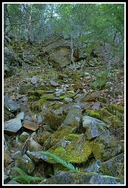 © 2006 Henk Wallays (1 of 20) |
|
|


|
Description In life, a broad brown and bronze dorsal stripe extends from the head to the tail. The sides of the body are chocolate brown. Most parts of the body are flecked with white and yellow spots, especially on the sides and on the limbs. The ventral surface is dark gray to purple and is mottled with light gray patches and some white flecking. The gular region has more dense white flecks. The chin is gray and somewhat mottled. Eyes are black with gold flecks on the upper and lower regions (Mead et al. 2005). Juveniles differ from adults in having two orange or red-brown stripes that extend from the eye toward the tail. The two stripes fuse into a single band just posterior to the vent. Dorsal stripes are lined with black pigment, which is replaced by brown pigment on the sides of the body. White or yellow flecks are concentrated on the dorsal surface of the head, the lateral parts of the trunk, and limbs. The ventral surfaces are dark gray to purple and have white flecks (Mead et al. 2005). Similar species: Plethodon asupak can be distinguished from the similar species P. elongatus and P. stormi by allopatric location, a wider head and longer limbs, a slightly shorter tail relative to the body length (tail/body ratio of about 0.80 in P. asupak vs. 0.85-0.90 in P. elongatus and P. stormi) and by generally having one less intercostal fold between adpressed limbs (limb interval of 2.5-3.5 in P. asupak vs. 5-6 in P. elongatus and 4-5 in P. stormi). It can also be distinguished from P. elongatus by larger size (average total length 111.3 mm for P. asupak males, and 125.0 mm for P. asupak females, vs. average total length of 91.6 mm for P. elongatus males and 97.4 mm for P. elongatus females). Distribution and Habitat Country distribution from AmphibiaWeb's database: United States U.S. state distribution from AmphibiaWeb's database: California
Life History, Abundance, Activity, and Special Behaviors Trends and Threats Possible reasons for amphibian decline General habitat alteration and loss Comments The specific epithet "asupak" is the Shasta Indian name for the area of the type locality. The Karuk tribe of Shasta Indians settled in this region and saw salamanders as omens of good luck and as serving to purify water (Mead et al. 2005).
References
DeGross, D. J., and Bury, R. B. (2007). . USGS, Reston, VA. Mead, L. S., Clayton, D. R., Nauman, R. S., Olson, D. H., and Pfrender, M. E. (2005). ''Newly discovered populations of salamanders from Siskiyou County California Represent a Species Distinct from Plethodon stormi.'' Herpetologica, 61(2), 158-177. Nauman, R. S., and Olson, D. H. (2008). ''Distribution and conservation of Plethodon salamanders on federal lands in Siskiyou County, California.'' Northwestern Naturalist, 89, 1-9. Stuart, S., Hoffmann, M., Chanson, J., Cox, N., Berridge, R., Ramani, P., Young, B. (eds) (2008). Threatened Amphibians of the World. Lynx Edicions, IUCN, and Conservation International, Barcelona, Spain; Gland, Switzerland; and Arlington, Virginia, USA. Originally submitted by: Christine Lu (first posted 2009-10-20) Edited by: Kellie Whittaker (2011-04-21) Species Account Citation: AmphibiaWeb 2011 Plethodon asupak: Scott Bar Salamander <https://amphibiaweb.org/species/6434> University of California, Berkeley, CA, USA. Accessed Apr 16, 2024.
Feedback or comments about this page.
Citation: AmphibiaWeb. 2024. <https://amphibiaweb.org> University of California, Berkeley, CA, USA. Accessed 16 Apr 2024. AmphibiaWeb's policy on data use. |
 Raffaëlli Account
 Map of Life